
Alarm Apps for Heavy Sleepers: 5 Features That Actually Get You Up
By the Alarmor founder · Sanora Technologies
·
An alarm app for heavy sleepers needs to do more than ring loudly — it needs to require a task before the alarm can be dismissed. The five features that matter are forced-task dismissal (math, movement, scanning an object), location missions that make you walk somewhere, difficulty that scales as you adapt, reliable delivery that bypasses silent mode and Do Not Disturb, and a fair fallback so you are never trapped.
What actually causes someone to be a "heavy sleeper"
Being a heavy sleeper is not a personality trait — it is a difference in arousal threshold, the amount of stimulus needed to wake someone from a given sleep stage. Deep slow-wave sleep is the hardest stage to wake from, and being woken abruptly out of it leaves the most grogginess afterwards. Sleep loss makes this worse, because it increases how much deep sleep you get (Tassi & Muzet, 2000). The threshold also varies naturally between people and across a single night, so the same alarm can wake you easily one morning and not at all the next. None of this is about willpower or trying hard enough; it is closer to a physiological setting than a habit.
Why heavy sleepers need more than volume
If you are a heavy sleeper, you have almost certainly already tried louder ringtones, vibration, and alarms placed across the room. These help marginally, but they all share the same weakness: they still end with a single, low-effort dismiss action. A heavy sleeper's brain is exceptionally good at performing that action while still mostly asleep — the alarm gets silenced and the memory never forms. This is sometimes called "alarm sleepwalking": the motor pathway for reaching over and tapping dismiss becomes so well-rehearsed that it survives even when almost everything else is still offline.
The 5 features an alarm app for heavy sleepers actually needs
Use these as a checklist for any alarm app you are considering. Volume is deliberately not on the list — every phone can already get loud enough. What separates an alarm that works for heavy sleepers from one that does not is what it demands from you before it goes quiet.
1. Forced-task dismissal
The alarm should not stop until you complete a real challenge — a math problem, a memory test, a set of shakes, a scan — rather than a swipe or a tap. This is the only mechanism that correlates with cognitive wakefulness rather than motor habit: you cannot solve "17 × 6" on autopilot the way you can hit a dismiss button.
2. Location missions that make you walk somewhere
For genuinely heavy sleepers, this is the most important feature on the list. A mission that requires walking to a physical object — a QR code or barcode on the bathroom mirror or a kitchen cupboard — is the only kind that makes falling back asleep physically inconvenient rather than just mentally undesirable. Once you are standing in another room, getting back into bed is a much bigger ask than it is after tapping a screen. If you would rather not place a code, an alarm that makes you walk a set number of steps gets you out of bed with no setup at all.
3. Difficulty that scales as you adapt
Heavy sleepers adapt fast. A mission that is genuinely challenging in week one is often trivial by week three unless it can get harder. Look for multiple difficulty levels and, ideally, the ability to combine two different missions on one alarm so a purely cognitive or purely physical response is no longer enough.
4. Reliable delivery on silent and Do Not Disturb
None of the above matters if the alarm does not fire. The app should use the platform's dedicated alarm channel so it rings through silent mode and Do Not Disturb, and on Android it needs to survive the aggressive background restrictions on Samsung, Xiaomi, Oppo, OnePlus and Vivo phones. An app that is upfront about the permissions this requires is a better sign than one that never mentions them — how alarm apps stay reliable without draining your battery explains what those permissions actually do.
5. A fair fallback so you are never trapped
An alarm with no failure mode is a liability. If a heavy sleeper genuinely cannot complete a task — the phone dies mid-mission, the registered object is out of reach while travelling — an alarm with no escape hatch either rings indefinitely or pushes you toward an unsafe workaround. The right design keeps the mission mandatory but bounds it with a timeout.
How Alarmor covers each of the five
We built Alarmor, a mission alarm app, around exactly this checklist, so it is worth being specific about how it maps:
- Forced-task dismissal — every alarm requires one of 15 missions across four categories: Brain, Physical, Location and Reflex. Maths Drill and Shake to Wake are both free.
- Location missions — Barcode Scan (free) works with any barcode already in your home; QR Code and Word Hunt are part of Alarmor Pro.
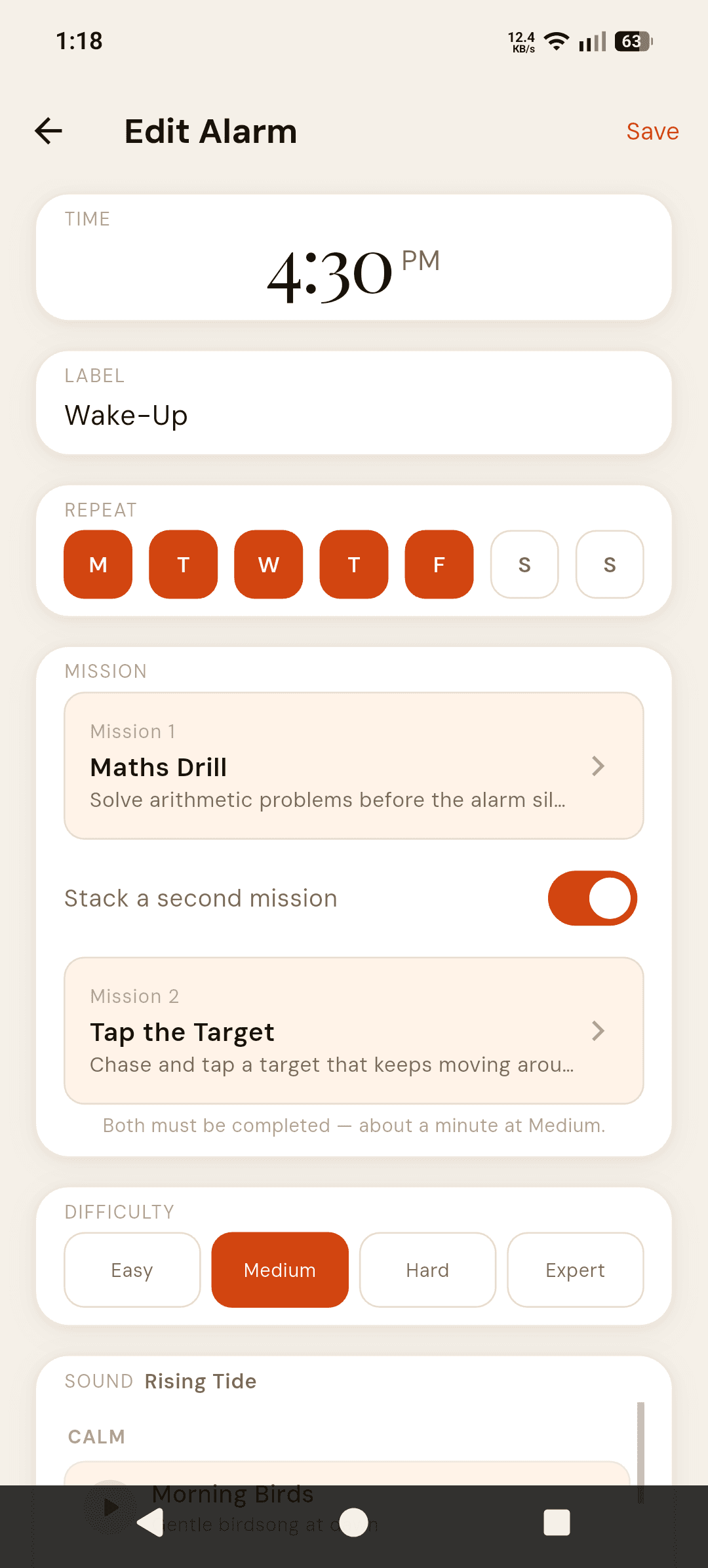
- Scaling difficulty — four levels from Easy to Expert (Easy, Medium and Hard are free), plus mission stacking in Pro to chain two missions on one alarm.
- Reliable delivery — Alarmor uses Android's dedicated alarm audio stream, so it fires at full volume on silent and Do Not Disturb, and asks for "Display over other apps" and "Unrestricted battery usage" so the mission screen actually appears.
- Fair fallback — the brain missions ease off if you keep missing (Maths Drill drops a difficulty level, Sequence Repeat shortens the sequence and Typing Challenge switches to a shorter phrase after three misses in a row, while Memory Grid gives you a longer look at the pattern), and if the mission still is not finished after five minutes the alarm dismisses itself and the morning is logged as incomplete.
Why combining categories works better than any single mission
No single mission type is bulletproof against a determined heavy sleeper — a math problem can eventually be solved half-asleep with enough repetition, and a shake pattern can be performed with minimal cognitive engagement once it is memorized. What tends to hold up is combining categories: a location mission that forces you physically out of bed, or mission stacking (an Alarmor Pro feature) that requires a physical mission followed immediately by a cognitive one. The value is not in any single mission being unbeatable — it is in making the combined effort of "get up, walk somewhere, and then also solve something" high enough that going back to sleep afterward stops being the path of least resistance.
A safety net that still respects your time
Any alarm app aimed at heavy sleepers needs an honest failure mode. If a mission genuinely cannot be completed — the registered object is out of reach while travelling, for instance — Alarmor automatically dismisses the alarm after five minutes rather than letting it run indefinitely, and logs that session as incomplete in your stats so you still get an honest picture of your mornings.
Frequently asked questions
Do heavy sleepers really need a mission-based alarm, or is a loud sound enough?
A loud sound alone rarely works for genuinely heavy sleepers because the dismiss action requires almost no cognitive engagement. A mission forces a real task — math, movement, or locating an object — which is much harder to complete while still asleep.
Will a mission-based alarm still wake me if my phone is on silent?
Yes, if the app uses the platform's dedicated alarm channel. On Android, Alarmor plays through the dedicated alarm audio stream, which rings through silent mode and Do Not Disturb. The iOS version is still in development.
What is the single most effective mission type for heavy sleepers?
Location-based missions such as Barcode Scan or QR Code tend to be most effective, because they require physically getting up and walking to another part of the room or house — a far bigger barrier to falling back asleep than any on-screen task.
Is being a heavy sleeper something you can change, or is a stronger alarm the only option?
Arousal threshold is influenced by sleep debt, sleep stage timing, and individual physiology, and reducing sleep debt can genuinely lower it over time. But on any given morning, a stronger dismissal mechanism — not a louder sound — is the more reliable lever, since it does not depend on how deeply you happen to be sleeping that night.
Can two mild missions together be more effective than one hard mission?
Often, yes. Mission stacking — completing a physical mission and then a cognitive one in sequence — tends to outperform a single very difficult mission, because it is harder to sleepwalk through two different kinds of engagement than to eventually brute-force one repeated task.
Sources
- Tassi P, Muzet A (2000). Sleep inertia. Sleep Medicine Reviews, 4(4), 341–353.
Ready to fight back against the snooze button?
Get it on Google Play →