
How to Build a Morning Routine That Actually Sticks, Using a Wake Streak
By the Alarmor founder · Sanora Technologies
·
A morning routine sticks when you can see the consistency building, not just when you have one good morning. Tracking a "wake streak" — consecutive days you actually complete your wake-up routine, not just days the alarm rang — gives you a visible, motivating measure of progress that a plain alarm clock never provides.
Why morning routines fall apart early
Most morning-routine attempts fail not because the routine itself is wrong, but because there is no feedback loop — and, often, because the morning never really starts: the alarm gets snoozed on autopilot. You wake up, you do (or skip) the routine, and nothing records whether that happened. Without visible tracking, one skipped morning feels the same as a string of them, so there is no accumulating cost to breaking the streak and no accumulating reward for keeping it.
The behavioral psychology of streaks
A visible streak works on two well-documented psychological levers at once. The first is loss aversion — the finding that losses weigh more heavily than equal gains (Kahneman & Tversky, 1979). Once a streak has some length to it, the prospect of losing it feels disproportionately bad compared to the modest effort of maintaining it, which is a stronger motivator on a hard morning than the abstract appeal of "building a good habit" ever is. The second is the same variable, visible-progress mechanism behind most habit-tracking tools: watching a number grow provides its own small reward independent of the underlying behavior, which is enough to carry you through the mornings when motivation alone would not.
What happens after you break a streak
Breaking a long streak is often the moment a routine collapses entirely, not because the habit itself weakened, but because the "all or nothing" framing makes one missed day feel like total failure. The healthier framing — and the reason total mission count matters alongside streak length — is treating a broken streak as a reset, not a verdict. A missed morning after a 40-day streak does not erase the other 40 days of built habit; tracking a lifetime total alongside the current streak keeps that context visible instead of letting one bad morning feel like starting from zero in every sense.
What to track if you want the routine to stick
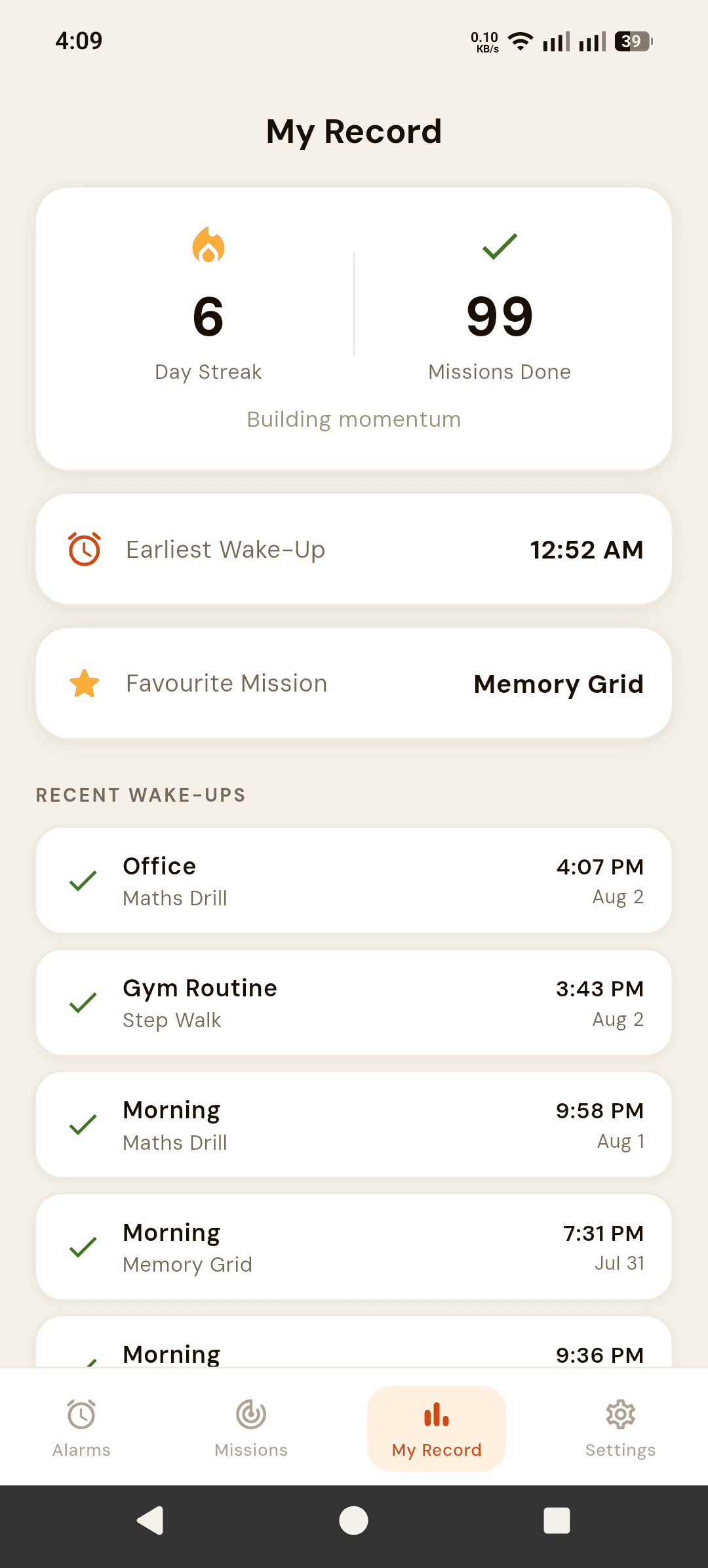
- Day streak — consecutive days you actually completed your wake-up routine
- Total completions — an all-time count that keeps growing even after a streak resets
- Your earliest wake-up on record — a personal best worth beating
- Which specific action you complete most often, so you can see what is actually working
- A log of recent history, so a single bad morning is visible as an exception rather than forgotten entirely
Why a mission — not just a wake-up time — is the right thing to track
Tracking the time you woke up is weaker than tracking whether you actually completed a real action, because a phone can register you as "awake" the moment you silence the alarm, even if you fall back asleep five minutes later. Tracking mission completion — a math problem solved, a set number of steps walked, an object scanned — is a much more honest signal that the morning actually happened the way you intended.
How Alarmor tracks this
Alarmor logs a completed wake-up only when the mission is actually finished, and shows your day streak, total missions completed, earliest wake-up, favorite mission, and recent history in one place. If a mission times out and the alarm falls back to auto-dismiss after five minutes, that session is logged as incomplete rather than counted as a win — so the streak reflects mornings you genuinely got up and did something, not mornings you slept through with the alarm silenced in the background.
A four-week framework for building the habit
- Week 1 — set the mission to Easy difficulty and pick whichever type feels easiest to actually complete every morning. The goal this week is purely showing up, not being challenged.
- Week 2 — once completing the mission feels automatic rather than effortful, move to Medium difficulty, or add a second free mission from a different category to rotate between.
- Week 3 — if a single mission has started to feel routine enough to perform half-asleep, that is the signal to increase difficulty again or, if you have Alarmor Pro, add mission stacking so a second, different kind of task is required.
- Week 4 — check your stats. A streak that has survived a full month, plus a rising total completion count, is a good sign the routine is taking hold. Do not expect it to feel automatic yet: in a study of people building a new daily habit, that took a median of 66 days, with a range of 18 to 254 (Lally et al., 2010). Keep going past the month.
Starting small beats starting ambitious
The routines that survive past the first month are usually the ones that start at Easy difficulty and scale up only once the habit is established, rather than starting at maximum difficulty and burning out within a week. Build the streak first; increase the challenge once consistency is no longer the hard part.
Frequently asked questions
What is a wake streak?
A wake streak is the number of consecutive days you have actually completed your morning wake-up mission — not just days your alarm rang, but days you completed a real, verifiable action before it stopped.
What happens to my streak if I miss a mission one day?
In Alarmor, a missed or timed-out mission is logged as incomplete and the streak resets, giving you an honest, motivating signal rather than letting a broken habit go unnoticed.
Do I need an account to track a wake streak?
No. Alarmor tracks your streak and stats locally on your device without an account. Creating a free account additionally backs up that history and syncs it across devices.
Should I panic if my streak resets after a long run?
No — a broken streak is a reset, not a verdict on the habit itself. Total completions and recent history give you the fuller picture; a single missed morning after weeks of consistency does not undo the habit that was actually built.
How difficult should my mission be while I am still building the habit?
Start easier than feels challenging. The goal in the first week or two is proving to yourself that you can show up consistently; difficulty is something to add once consistency is no longer in question, not before.
Sources
- Kahneman D, Tversky A (1979). Prospect theory: An analysis of decision under risk. Econometrica, 47(2), 263–291.
- Lally P, van Jaarsveld CHM, Potts HWW, Wardle J (2010). How are habits formed: Modelling habit formation in the real world. European Journal of Social Psychology, 40(6), 998–1009.
Ready to fight back against the snooze button?
Get it on Google Play →